Skills-Based Hiring at Scale: How AI Interview Tools Are Enabling Fairer, Faster Talent Decisions in 2026
The hiring landscape of 2026 looks fundamentally different from just three years ago. Where organizations once relied on degree requirements, prestigious employers, and years of experience as proxies for capability, a growing number of forward-thinking companies have shifted toward a more direct measure: skills.
This transition—from credential-based to skills-based hiring—is not merely a philosophical preference. It is a structural response to a rapidly changing labor market where the half-life of credentials is shrinking, talent pools are global, and the cost of a bad hire has never been higher. AI-powered interview tools are at the center of this shift, enabling organizations to assess competencies at scale with a consistency and depth that human-only processes cannot match.
In this article, we examine how skills-based hiring frameworks work in practice, how AI interview platforms support their implementation, and how organizations can adopt these methods to improve both the quality and fairness of their hiring decisions.
Why Credentials Are No Longer Enough
For decades, hiring relied on credentials as convenient filters. A university degree signaled work ethic. A well-known employer on a resume implied capability. These shortcuts reduced the volume of decisions hiring managers had to make, but they also introduced persistent blind spots.
Research consistently shows that credential-based filtering systematically disadvantages candidates from under-resourced backgrounds, non-traditional career paths, and career changers—regardless of their actual ability to perform the job. At the same time, organizations that relied on these filters increasingly found that credential-matched hires did not always outperform less credentialed peers in practice.
The shift toward skills-based hiring addresses this mismatch. Instead of asking "Where did this person study?", hiring teams ask "Can this person actually do the work?" The answer requires evidence—structured demonstration of relevant competencies—rather than inference from background signals.
Defining Competency Frameworks for AI-Supported Assessment
Skills-based hiring at scale begins with a well-defined competency framework. A competency framework translates job requirements into observable, measurable behaviors that assessors—human or AI—can evaluate consistently across candidates.
Effective competency frameworks share several characteristics:
- They are specific to the role and level, not generic
- They describe behaviors that can be elicited through structured questions
- They include clear scoring rubrics with behavioral anchors
- They distinguish between threshold competencies (minimum requirements) and differentiating competencies (predictors of high performance)
- They are reviewed periodically to remain aligned with evolving role requirements
When an AI interview tool is calibrated against a well-designed competency framework, it can analyze candidate responses for evidence of the defined behaviors—at a consistency that eliminates interviewer fatigue, scheduling bias, and informal scoring variation.
How AI Interview Tools Support Skills-Based Assessment
AI-powered interview platforms contribute to skills-based hiring in several distinct ways. Understanding these contributions helps organizations deploy them strategically, rather than treating them as wholesale replacements for human judgment.
Structured Question Delivery: AI interview tools ensure that every candidate receives the same questions in the same order, eliminating the informal variation that occurs across different interviewers and interview days. This structural consistency is a prerequisite for fair comparison.
Competency Signal Extraction: Trained on structured behavioral interview methodologies, modern AI systems can identify whether a candidate's response demonstrates the competency being assessed—not just whether the response was fluent or confident. This separates communication style from actual evidence of skill.
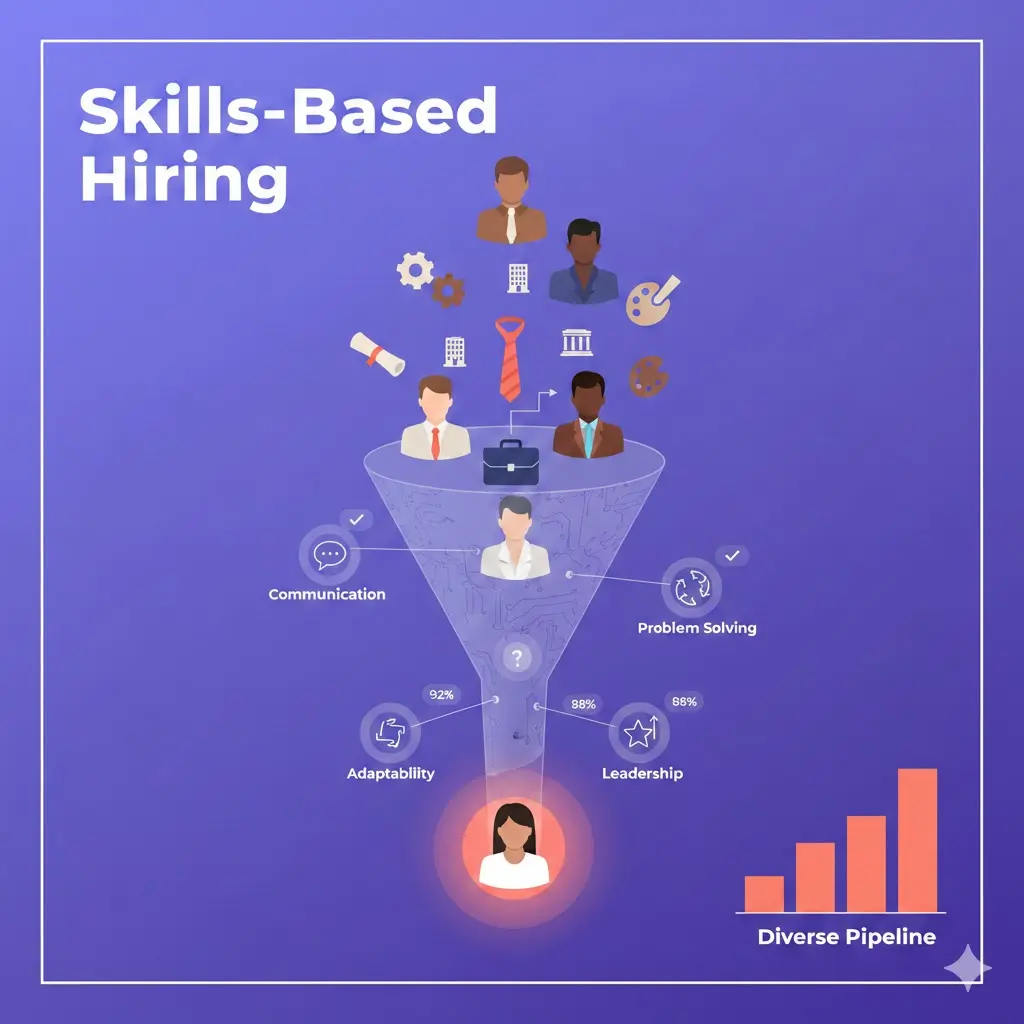
Scalable Screening: Skills-based screening traditionally required significant interviewer time. AI interviews allow organizations to conduct structured competency assessments for every candidate in a pipeline—not just a shortlisted subset—ensuring that strong candidates from non-traditional backgrounds are not filtered out before a human ever reviews them.
Objective Documentation: AI systems generate score records tied to specific competency dimensions, creating an audit trail that supports both compliance requirements and continuous improvement of the hiring process.
Measuring What Matters: Key Metrics for Skills-Based Hiring
Skills-based hiring only improves outcomes if organizations measure its impact. Without measurement, the shift from credentials to competencies is merely cosmetic. Key metrics for evaluating the effectiveness of a skills-based AI hiring program include:
- Candidate quality rate: Proportion of candidates who advance past the first 90 days performing at or above target levels
- Screening accuracy: Correlation between AI competency scores and subsequent performance evaluations
- Pipeline diversity: Demographic representation at each stage of the hiring funnel, compared to credential-screened baselines
- Time-to-competency signal: Average time from application to structured competency assessment completion
- Override patterns: Frequency and rationale for human overrides of AI scores, which reveal calibration issues
- Adverse impact indicators: Statistical monitoring for unintended score disparities across protected groups
These metrics create a feedback loop that improves both the AI system and the competency framework over time.
Integrating Human Judgment Into a Skills-First Process
Skills-based AI hiring does not eliminate human judgment—it sharpens it. When structured AI assessment handles the first layer of competency evaluation, human interviewers can focus their attention on the dimensions that AI cannot yet reliably assess: cultural alignment, growth trajectory, leadership potential, and contextual fit.
A well-designed integration model includes:
- AI-structured screening for threshold competencies across the full candidate pool
- Human-reviewed shortlisting based on AI competency scores plus recruiter context
- Calibrated second-round interviews focused on differentiating competencies and role fit
- Documented override processes with clear escalation criteria
- Regular debrief sessions where hiring teams discuss both AI scores and their own assessments
This model preserves recruiter expertise while expanding the effective reach of the hiring process. It ensures that more candidates receive a fair, structured evaluation—not just those who reached the top of a credential-sorted list.
Building Candidate Trust in a Skills-Based AI Process
Candidates approaching an AI-supported interview process often carry uncertainty: What is being measured? How will results be used? Is the process fair?
Organizations that address these questions proactively experience higher completion rates, stronger candidate satisfaction, and better representation across diverse talent segments. Effective candidate communication for a skills-based AI process includes:
- A clear explanation of the competencies being assessed and why they matter for the role
- Transparency about how AI scoring works and what human review follows
- Practical guidance on how to approach structured competency questions
- A straightforward process for requesting review or clarification
- Post-assessment communication regardless of outcome
Candidate trust is not just an ethical consideration—it is a competitive differentiator. Organizations that make their process feel fair and transparent attract candidates who are more engaged, better prepared, and more likely to become effective employees.
Two Practical Checklists for Implementation
Checklist: Launching a Skills-Based AI Interview Program
- Define role-specific competency frameworks with behavioral anchors
- Validate competency criteria against current high performers
- Configure AI interview tool to deliver structured, competency-aligned questions
- Set score thresholds for each competency tier
- Train hiring managers to interpret AI competency scores
- Develop candidate transparency notice explaining the process
- Establish override documentation protocols
- Schedule quarterly competency framework reviews
Checklist: Evaluating Program Effectiveness After 90 Days
- Review candidate quality rate versus credential-screened baseline
- Analyze screening accuracy against 90-day performance data
- Assess pipeline diversity across demographic segments
- Audit override frequency and identify patterns
- Collect candidate satisfaction data from completers and non-completers
- Identify competency dimensions with low predictive validity for recalibration
- Report findings to senior HR leadership with recommended adjustments
Turning Skills-Based Hiring Into a Long-Term Talent Advantage
Organizations that make skills-based hiring a durable practice—not just a one-time initiative—build structural advantages in talent acquisition. Over time, a calibrated skills-based hiring program creates:
- A validated, proprietary competency dataset tied to performance outcomes
- A more diverse pipeline that draws from a wider range of talent sources
- A consistent hiring experience that candidates respect and recommend
- Reduced time-to-productivity for new hires whose assessed competencies match their roles
- A defensible, audit-ready hiring record that meets regulatory expectations
In a labor market where top candidates have many options, the quality and fairness of the hiring process itself is a signal. Organizations that invest in rigorous, transparent, skills-based evaluation stand out—not just as ethical employers, but as high-performance organizations that take talent seriously.
Conclusion
Skills-based hiring is no longer an aspirational framework—it is a practical methodology that AI interview tools make scalable for organizations of any size. By defining clear competency frameworks, deploying structured AI assessment, measuring outcomes rigorously, and integrating human judgment strategically, companies can build hiring processes that are both fairer and more effective.
The shift from credentials to competencies requires deliberate design and consistent measurement. But for organizations willing to invest in that work, the result is a talent acquisition engine that finds and selects strong candidates regardless of where they came from—focusing instead on what they can actually do.
Ready to build skills-based AI interview workflows for your organization? Learn more about our AI hiring platform or get in touch with our team.